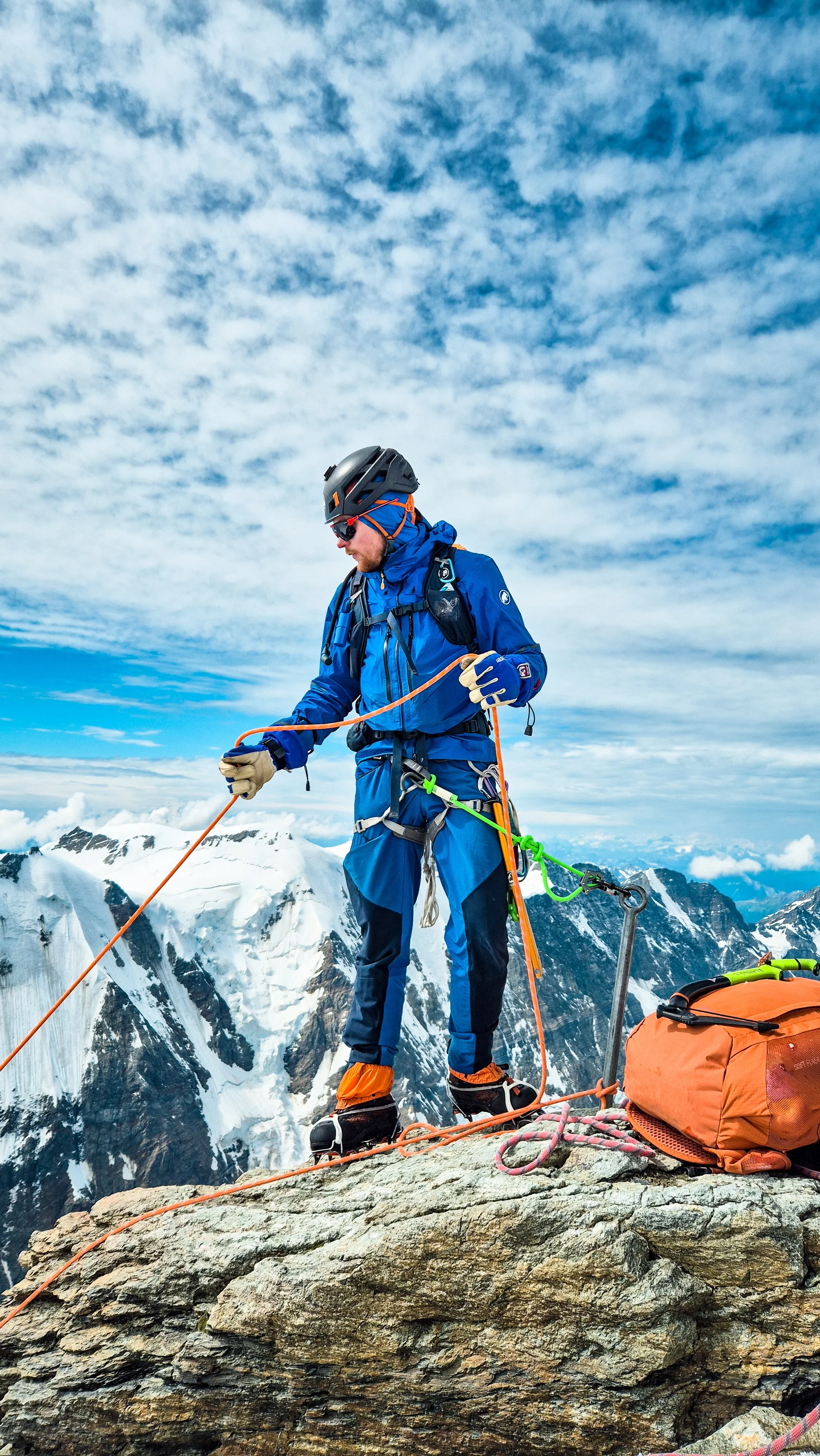
Let's climb to the top of the European Union!
Group occupancy: 2/12
Come see what the Alps look like from their highest peak! Let's go to Mont Blanc via the Italian route. It is technically more interesting and objectively more difficult than the standard Goûter route in France.
Mont Blanc probably needs no introduction — it’s a 4807m-high snow-capped peak right on the border of France and Italy, considered the highest peak in both countries and Western Europe. Set amidst an idyllic mountain landscape, the extremely popular peak is probably every mountaineer’s dream. to do in the list.
Please note: You can apply for this trip, but you will not be automatically registered. Filling out the registration form does not guarantee the right to join the trip until the guides have reviewed your application and assessed your fitness to be suitable for this peak. When assessing, we take into account physical fitness, lifestyle activity (how much you exercise and/or long sports events you do) and previous experience. This is to ensure that the probability of reaching the top of the group is as high as possible and that participants are not put at risk due to insufficient preparation.
Mont Blanc is not the best choice for a first mountaineering experience. The climb is long and physically very difficult. If you are strong, athletic and brave, you can easily manage the summit of Blanc. If you have no previous experience, we recommend booking an Alpitrio trip in advance.to learn how to use crampons and a pickaxe and to strengthen your skills on rock routes. In addition, the Alpitrio trip creates a good acclimatization base, which will significantly help with the summit climb.

The Mont Blanc summit day is also preceded by a thorough acclimatization program, during which we train our bodies to cope with altitude, practice moving on the glacier and using mountaineering equipment. To enrich our summit lists, we will also climb to the top of a 3000+ m mountain during the acclimatization. Which one - it will be determined according to the group's ability and weather conditions.
During acclimatization and the ascent of Mont Blanc, we will stay in cozy mountain huts, where it is nice to sleep warmly and even enjoy a three-course dinner.
When we are not on the mountain, we base ourselves in the beautiful small town of Chamonix, which offers a magnificent view of Mont Blanc and therefore attracts people from both far and near to visit us. We spend the night in tents at the campsite and cook our own meals using camping stoves, buying the necessary food from the local shop. However, there are also many restaurants near the accommodation where we can also eat.
Overview - short & sweet
Goal: Mont Blanc 4807 m
Dates: 21.-30.06.2027
Activity: mountain climbing, mountain hiking
Accommodation: tents in the village below, mountain huts in the mountains
Adventure guides: Kaarel Kuslap
Technical difficulty level: 3/5
Route difficulty: PD+ to AD (steep slopes, volatile weather conditions, need for trad equipment)
Physical difficulty: 3.5/5 (requires good physical fitness)
Group size: min 6, max 10 (+2 to 3 locomotives)
TOUR PRICE:
Early bird (until 21.10.2026) - €2190
Standard Registration (22.10.2026 - 28.01.2027) — €2290
Late Registration (from 29.01.2027) — €2390
NB! Elamus+ community members get a 5–10% discount. Read more and check your discount eligibility. community members page.
👉 SEE EQUIPMENT LIST HERE 👈


Travel cost
Price includes
Trip organization and on-site guidance by a multi-experienced Mont Blanc adventure coach + experienced assistant coach
All overnight stays (cabins in the mountains, camping fees at the campsite below)
Breakfast and dinner in mountain huts
Gondola tickets during the mountain program
Group climbing equipment (ropes, ice augers, trad equipment, carabiners, etc.)
Stylish Elamus+ designed sports shirt
Group pharmacy (including high-altitude medications)
Equipment needed for communal meals (stove, gas, and cooking utensils)
Elamus+ mountaineering preparation package worth €350:
access to online mountaineering webinars;
A sample training plan and workbook for mountain hikers
online pre-trip preparatory briefing;
winter mountaineering training before the trip*;
summer mountaineering training before the trip*.
*Held once a year in Estonia — participation depends on the time of registration.
Price does not include
Flight tickets Tallinn-Milan-Tallinn (prices with checked baggage from €350)
Bus Milan-Chamonix-Milan (round trip approx. €60)
Insurance (travel insurance and MANDATORY sports insurance suitable for mountain hiking)
Personal hiking and climbing equipment (can also be rented) from us)
Drinks and snacks (including lunch) on the mountain
Meals off the mountain
Tents and other overnight equipment at the campsite
Food containers and personal cooking equipment at the campsite
Unscheduled excursions, transportation, etc. (or if you want to do something extra)
Applying for a trip
Before applying, please familiarize yourself with travel conditions. The locomotives will review your application and contact you for additional information if necessary. You will receive a decision on your admission to the trip within 5 days.
Apply for the trip if at least 2 of the following statements apply to you:
Do aerobic exercise weekly
In addition to aerobic exercise, you occasionally do strength training or go climbing.
You have participated in sporting events during which you are in motion at a higher heart rate for at least 3 hours in a row (for example, various marathons)
You have participated in a sporting event during which you are moving at a lower heart rate for at least 6 hours in a row (for example, various hikes, Kondimootor, Adventure X, etc.)
You have previously hiked or climbed to an altitude of at least 3500 m
To secure your place on the trip, a deposit (20%, non-refundable) must be paid within 3 business days of receiving the confirmation and invoice by email. If there are less than 30 days left until the trip, the total cost must be paid after receiving the corresponding invoice (100%). Read more: frequently asked questions ja package tour information sheet.
NB! We recommend taking out travel disruption insurance immediately after paying the advance invoice so that longer-term health problems are also covered!
Schedule and activities
Day 1 (21.06) - Chamonix
Everyone arrives in Chamonix at their own time and in their own way. The easiest way to get to Chamonix is to fly to Geneva and take a 1-2 hour bus directly to Chamonix, or fly to Milan and drive to Chamonix.
Destination in Chamonix: Les Arolles campsite on the edge of town, we will stay in our own tents and cook for ourselves. There are numerous different hiking shops in town where you can stock up on equipment if needed. Please be there no later than 6:00 PM. - we will brief you about the upcoming trip and get to know each other.
The driver's recommendation: if possible, arrive a day early so that you have time to deal with delayed luggage (this often happens when flying to Geneva) or look for missing equipment. And otherwise, it's also nice to explore around. It's a beautiful place!
Day 2 (22.06) - acclimatization begins
In the morning we take a bus down the mountain instead of to the top, and take a gondola from the other side of the town of Entreves to the Torino hut. Since this is not a beach holiday, after lunch we put on glacier equipment and go to the glacier near the hut to learn rope walking and self-braking with a pickaxe. At the hut we can enjoy a refreshing dinner and beautiful views of the surrounding mountains.
meters of ascent: 0 (we enjoy the views from the gondola)
duration of the hike: 2-3 hours (leveling up training in tying ropes on the glacier)
Hut altitude: 3382 m
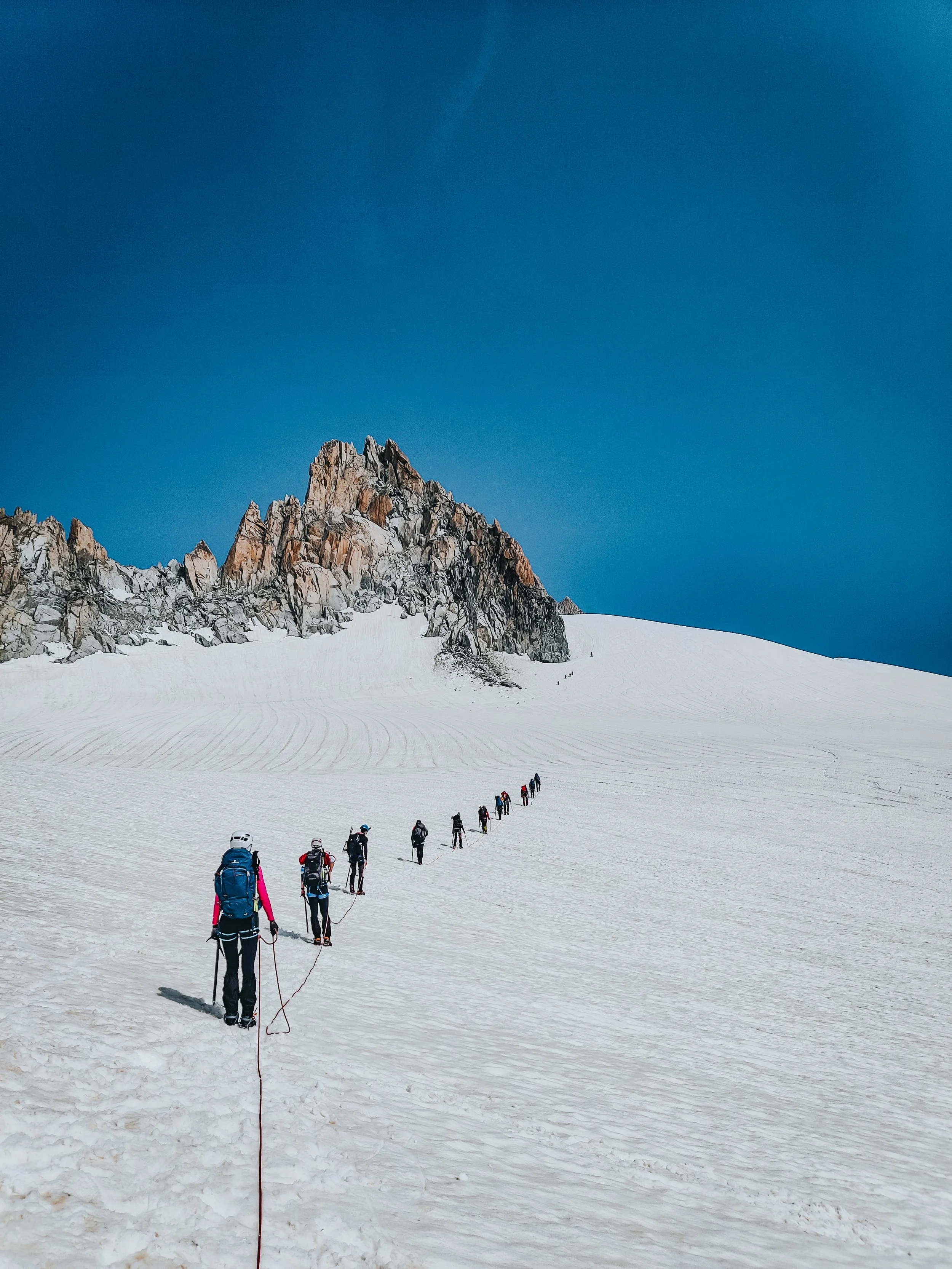
Day 3 (23.06) - Acclimatization and exciting climbing
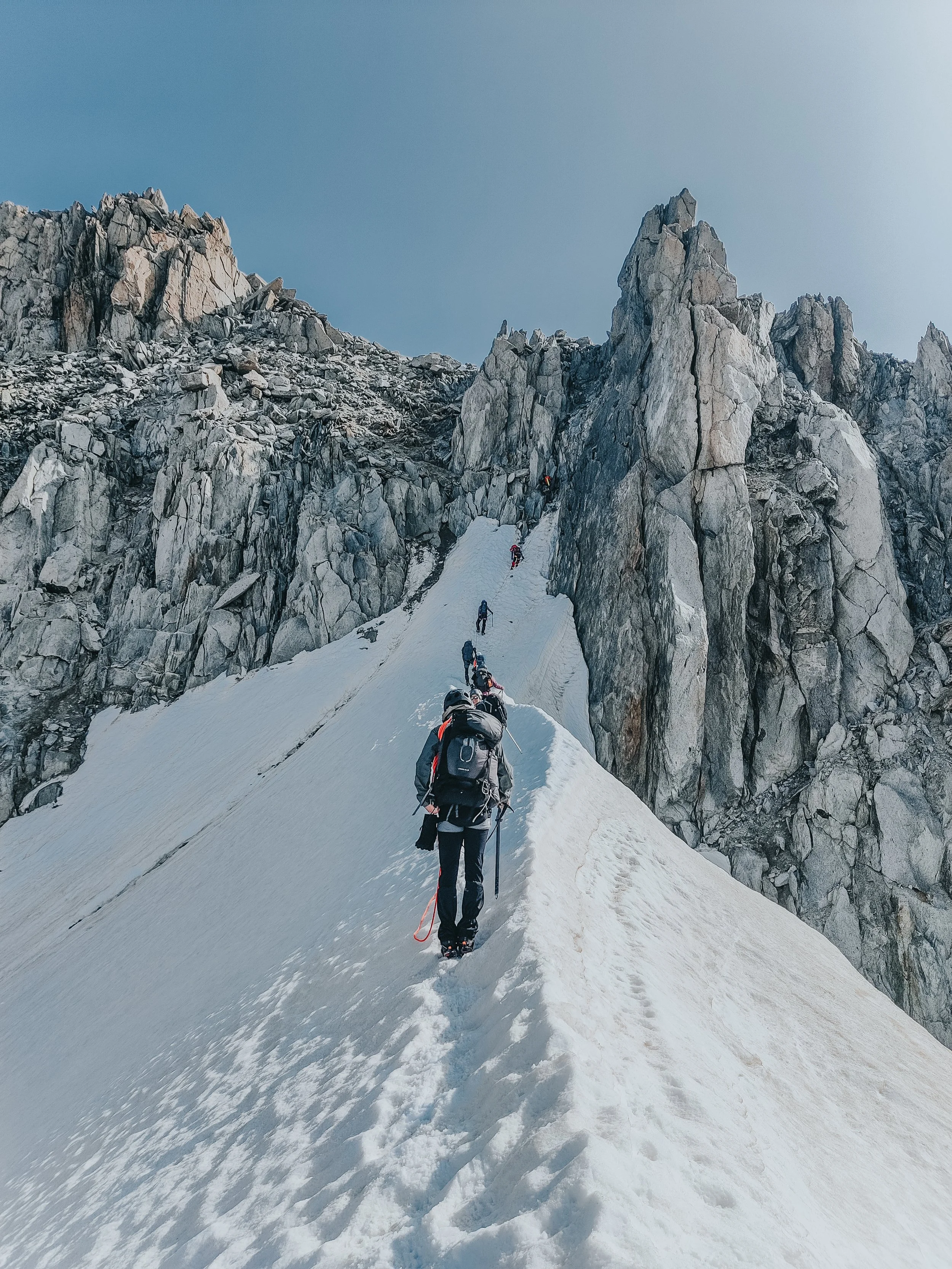
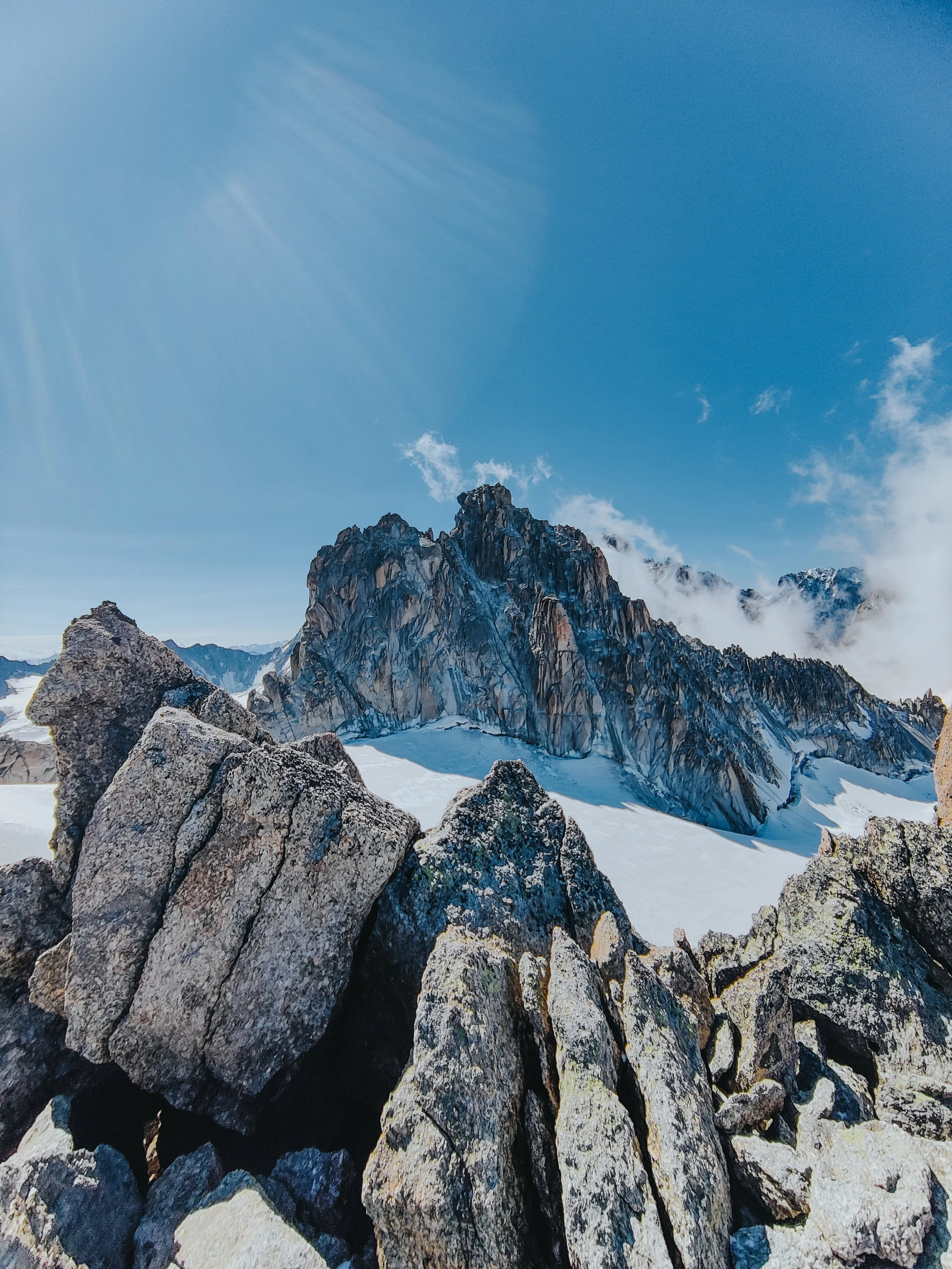
In the morning we start moving across the glacier until we reach a rocky ridge and can challenge ourselves by rock climbing to the top of the Aiguilles d'Entrèves. There we will take famous Instagram photos while climbing the cliffs, enjoy the views and descend back to the Torino hut for the evening.
ascent meters: 280-350
hike duration: 4-7 hours
Peak height: 3600 m
Day 4 (24.06) - BACK TO GREEN
In the morning we pack up our things from the hut and descend back to the Courmayer valley the way we came, spend the night in a hut there and start preparing our minds for the great white mountain.
Day 5 (25.06) - the journey to the top of the white mountain begins
The goal is to reach the Gonella hut. To do this, we have a long climb over the glacier, before we can touch the rocks with our hands again. It is a rather small but lovely hut, where we can fill our bellies with a three-course dinner and prepare ourselves for the summit assault.
Ascent meters: 1600 m
hike duration: 6-7
Hut altitude: 3072 m
Day 6 (26.06) - you can smell the peak in the air
We will stay at the Rifugio Francesco Gonella hut for three nights to allow time to consider the weather and the condition of the group. The summit attack may take place either today or tomorrow.
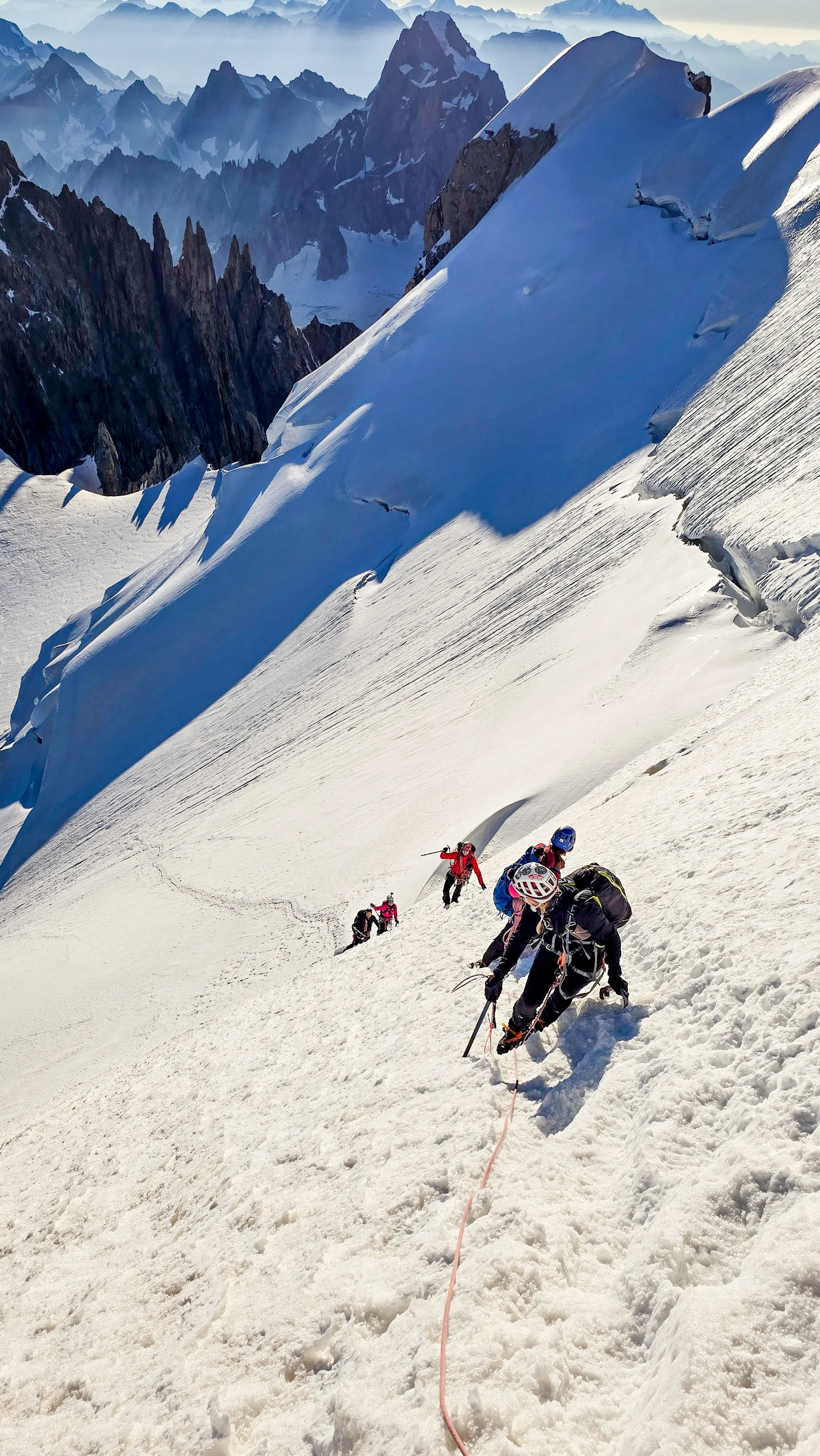
We wake up in the early hours of the morning and start moving along the rope with our headlamps — one foot in front of the other, getting closer and closer to the roof of the European Union. The journey to the top should take about 7-10 hours from base camp and about 6-7 hours to get down, so it will be a long and exhausting day.
We move along the glacier, roped through crevasses. There is a lot of climbing and the altitude increases quickly. Next comes the first serious technical section of the day. In the upper part, you have to cross a foot crevasse area. Then the trail goes up a steep snow and rock slope and you reach the ridge of the Aiguilles Grises. Depending on the conditions, this section can be very different: soft snow, hard ice or mixed terrain.
This is where the tough part of the Italian route begins. We climb along the Aiguilles Grises ridge to the small rocky peak of Piton des Italiens – 4003 m. The ridge is narrow and snowy.
We continue along the ridges over the summit of the Dôme du Goûter and join the regular Mont Blanc route. So, about halfway through the summit day, the environment and route become noticeably more crowded.
Next comes the classic climb to the top of Mont Blanc - We are already over 4300m above sea level and the altitude is starting to strongly affect the pace. Just for dessert before the summit we get the most technical and open part of the day and And voilà! Welcome to the top of the European Union!
But that's not all - you have to go back to the hut the same way to eat and sleep.
Ascent meters: 1739 m
hike duration: 12-16h


Day 7 (27.06) - Mont Blanc has become home
If the weather was bad the day before, the summit day will have to be done today. However, if we are already tired and exhausted from the wonderful summit day, we can celebrate and rest in the hut, or, depending on the group's wishes, hike back down.


DAY 8 (28.06) - back to the valley
After a long sleep, we descend back into the valley and take the bus back to the familiar Chamonix village. We can check out the local restaurants and celebrate a successful trip.
descent: 1600 m
hike duration: 4-5 hours
Day 9 (29.06) - back home
We pack up at camp and head home. Or to the next adventures - who knows how. Anyway, one thing is clear: regardless of whether we managed to stand on the top of Mont Blanc a few days ago or not, we will all go home richer with unforgettable memories and powerful experiences!
Day 10 (30.06) - flight day
Pack your bags and get on the bus and then on to the plane.
NB! There may be minor changes to the schedule and planned activities - for example, due to weather and conditions or passenger requests.
Don't worry, let's do it!
How physically fit do I need to be to reach the peak?
Mont Blanc requires good physical fitness and mental stamina, as the summit day is very long. In addition, you need a firm footing on the steeper sections.
Due to the individual characteristics and sports preferences of people, it is difficult to provide uniform indicators for assessing good physical fitness. To give a few examples, a person in good physical shape can run a half marathon in under 2,5 hours, a marathon in under 6 hours. Or cycle 130-150 km in a row. Or complete the main distance of the Tartu Marathon in February. It is important that your body can work with a high pulse for several hours in a row and your leg muscles can push you up a hill several hundred meters. At least as important is mental endurance during long, intense activities (motivating yourself, dividing the journey into sections, walking in silence in your thoughts).
But I don't have any hiking gear, who can afford to buy it?
You'll still have to spend a little, but not much. Hiking and climbing equipment can be rented at a very reasonable price and, of course, borrowed from friends. In addition, you can use any kind of existing clothing; for example, a ski jacket is also very good for the mountain. The more resourceful can manage almost without additional expenses. Special equipment can also be rented.
What you definitely shouldn't skimp on are decent waterproof mountain boots with a stiff sole. A stiff sole ensures that the crampons don't come off your boot in the middle of the mountain and that your feet don't get so tired on rocky ground. Read more about it FROM HERE.
Will I survive?
It's an extreme sport/hobby, but you shouldn't be too afraid here. Of course, there are certain dangers in the mountains and you have to take them into account, but accidents happen in everyday life too. The most important thing for the group leader is to ensure the safety of the participants — to do this, we learn and use correct mountaineering techniques and turn around if the weather gets too bad. The point is still to have an enjoyable experience and not let this mountain go away. ;)
Okay, I registered. Now what?
Well, theoretically you could just vanish into thin air and appear on a plane, but then you risk discovering “oops, I have the wrong crampons and what is this middleman node?” on the spot. It can happen, but we highly recommend participating in preparatory events — it’s part of the fun. We organize preparatory hikes and trainings, advise on suitable insurance and equipment, where to rent cheaply, what to train for, etc. We will definitely review the equipment you have collected just before the start of the trip and send reminders about important things.
Read more also frequently asked questions.
Travel documents and footnotes
The participant is responsible for the validity and condition of their travel documents. For this trip you will need:
ID card/passport;
sports insurance suitable for mountain hiking (read more on the FAQ page). A suitable sports insurance policy must be carried and is a prerequisite for participating in the mountain hike;
travel insurance. NB! Take out insurance immediately after registering for the trip to ensure that you can get back any expenses incurred (for example, any advance payment) in the event of an unexpected event..
Plan your trip early and start training for it. We will organize several trial trips, training sessions and recommend training plans beforehand. It would be a shame if the peak was only behind the physique. Also a good opportunity to get in shape. ;)
Summits are not guaranteed. As you might expect, weather is king in the mountains. So it is entirely possible that weather or dangerous conditions will prevent us from even attempting the summit. Nevertheless, it will definitely be an awesome experience!
Although at the end of the day everyone is still responsible for their own actions and consequences, we do our best to mitigate the risks associated with mountaineering. As a result, the group leader has the right to make ongoing decisions about the competence of the participants, the suitability of their equipment, physical/mental capacity, etc. and, if necessary, for example, to prohibit participation on summit day if it endangers the health of the group or the participant themselves. Hopefully, of course, there will be no need for this.
Read also travel conditions.