
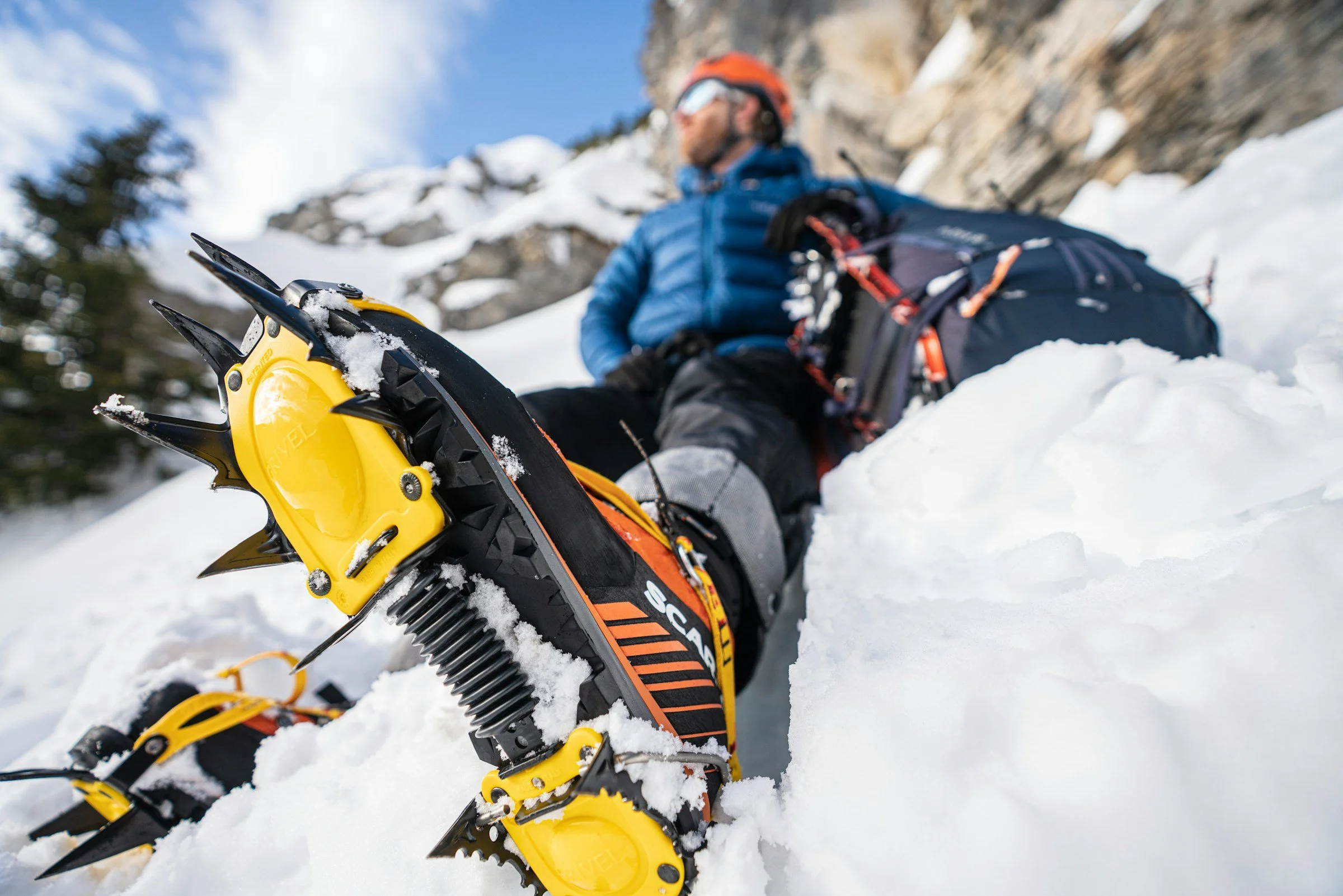
Crampons

When you go climbing mountains, you'll have to deal with not only the choice of clothing, but also technical climbing equipment. Crampons, picks, belts, carabiners... all this new information will probably be overwhelming at first.
This page is your lifeline in this case. We will briefly summarize all the basics regarding the different equipment elements - what options exist and how to choose the most suitable one for you.
First, find out what equipment you need for your specific adventure. The choice of equipment depends primarily on the route/mountain you choose, and you don't need to carry an armada of technical equipment everywhere.
“Kassid” are four-legged furry creatures that say “meow.” Or they’re sharp metal spikes — crampons — attached to mountain boots to help you move safely on glaciers. Here, we’re talking about the latter.
Crampons are classified by the number of points (teeth) and their attachment system. But the very first step in choosing crampons is actually to look closely at your boots. Although there are crampons that fit almost any kind of boot, it’s not always wise to attach them to just any boot.
To move comfortably with crampons, your boots must have a completely stiff sole, specially designed for mountain use.<font></font>
If you spend hours or even days walking with crampons on soft, flexible boots, you risk damaging both the boots and the crampons.<font></font>
Crampons are made of rigid metal, and if the flexible sole of your boot bends with every step, it will eventually cause the metal to weaken and break.<font></font>
Similarly, crampon straps rub against the boot’s outer surface, and because the boot bends, you’ll need to constantly adjust the straps on the glacier. So, one thing you definitely shouldn’t skimp on in the mountains is a good pair of mountain boots.<font></font>
You can read more about boots FROM HERE.
Number of teeth

With 8-10 teeth Cats are best suited for crossing flat glaciers or walking on very steep slopes. Their teeth are arranged in such a way that they can move as comfortably and easily as possible on flat ground, but they may lack the number of fangs to climb steeper slopes.
Model examples: Grivel G10, Petzl Irvis, Stubai Trekking.

With 12 teeth cats are ideal for classic alpinism, where you may also need front pointing skill (climbing by digging their front teeth into the ice). Compared to 10-toothed cats, they have 1 extra pair of teeth added under the middle of their feet to ensure better grip, especially when moving on steep slopes.
Examples of models: Grivel G12, Singing Rock Fakir III, Petzl Left.

With 14 teeth crampons are designed for ice climbing. They usually have serrated front teeth on the bottom to provide even better grip on icy vertical walls. Another pair of teeth is also added to the head. Several models have the option of replacing the 2 front teeth with one, which is preferred for technical mixed climbing (both on rock and ice). However, climbing easier alpine routes with such crampons is rather uncomfortable and they are also more expensive.
Model examples: Grivel G14, Petzl Lynx, Singing Rock Lucifer III
Fastening systems

With universal mount The boots are attached to the boot with straps. They can be attached to any boot, regardless of the shape of the boot or the presence of a special fastening groove on the boot. Although such a universal solution may seem convenient, constantly tying the straps is actually quite annoying and they sometimes tend to loosen during long walks. Still, a good choice for a beginner.

With quick release The crampons are attached to the boot using a metal attachment - one on the heel and the other on the toe. However, this requires that the heel and toe of your boot have special grooves for quick-release fasteners. Quick-release fasteners are a convenient and quick solution for installing crampons. However, when using quick-release fasteners, you must be careful to ensure that they are attached in exactly the right place, because you can easily lose the crampon while on the mountain. Correctly installed quick-release fasteners ensure a less mobile attachment than a universal fastener.

Hybrid mount are, as the name suggests, a combination of the two mentioned above. They have a quick release on the heel and a universal strap fastening on the toe. Such combo ensures quick and convenient fitting of the crampons, but reduces the risk of the crampon suddenly slipping off your foot while on the mountain. The heel strap is more common on mountain boots than the toe strap.
What else should you consider when choosing cats?
Your foot size - if you have very large or small feet, make sure the boots fit them. Most boots are adjustable from 36-46, some are also suitable for larger feet. If your feet are even larger, you may need an additional cat extensions — a metal extension to increase the length of the cat.

Crampons should definitely have anti-balling plates under the sole. These prevent snow from building up beneath the crampon. This, in turn, helps avoid the dangerous situation where you step not on the crampon, but on a snowball — and risk slipping.
crampon bag A durable bag made specifically for storing crampons, designed to prevent them from damaging surrounding items or living beings.